Procare: Registration
Ux DesignProject
- Advanced Registration
- Web Application
Deliverables
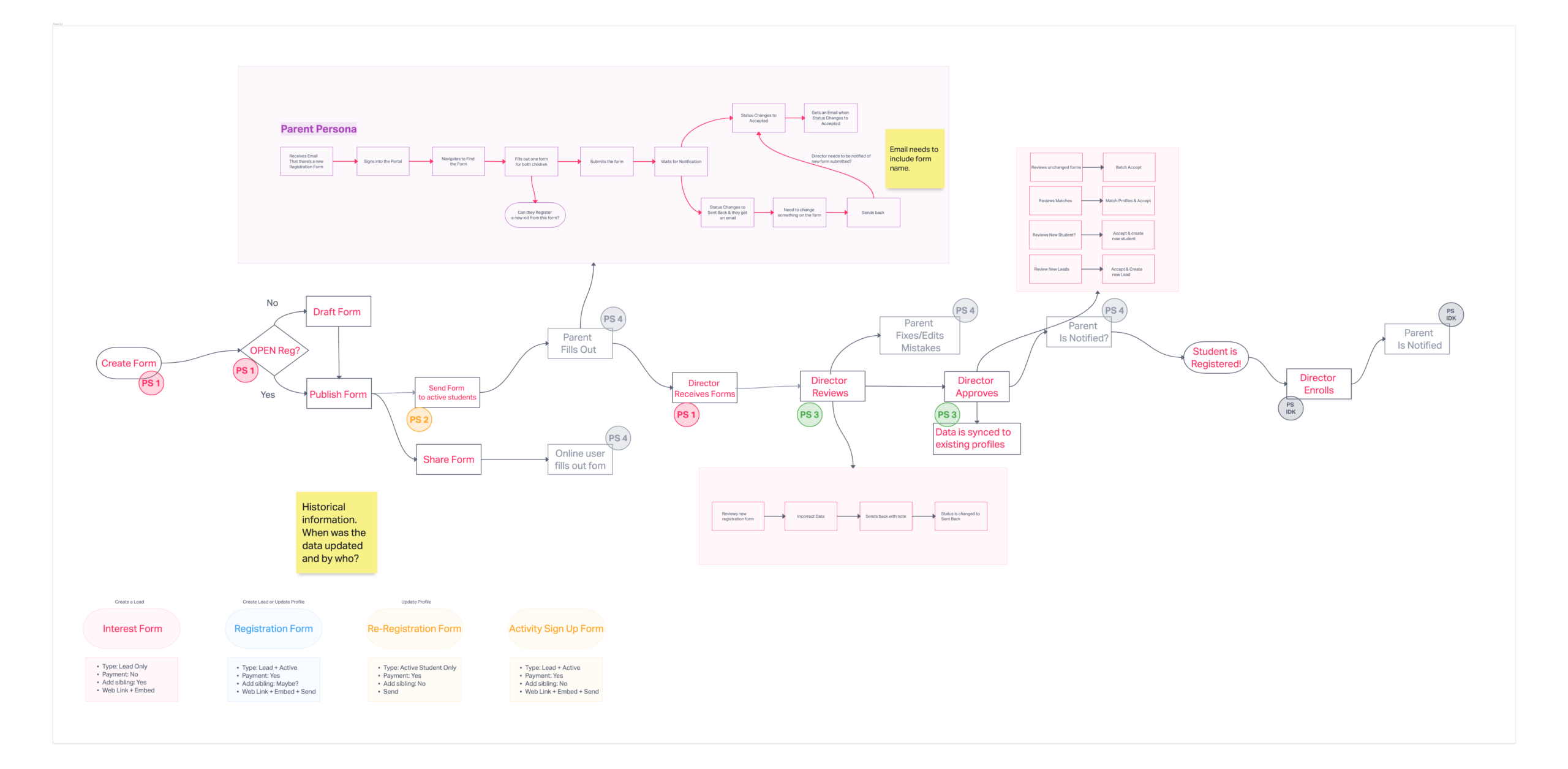
- Alignment Diagrams
- Clickable Prototype for Customer Interviews
- Wireframes
- Dev-Handoff Figma File
Roles
- UX Research Assistant
- Various rounds of walkthroughs and interviews
- Competitor analysis
- Research synthesis
- UX Designer
- Solutions
- Figma High Fidelity Wireframes
- Tri-Team Member
- Helped PM with Problem Statements
- Helped to assess feasibility
- Assisted with measuring success metrics
- Overall vision for registration
- Dev Handoff
- Sign off at end of sprint
Project Info
Challenge
Unlike greenfield work, this registration initiative required operating within a legacy system that was not designed for scale. The existing tools and codebase were outdated and optimized for immediate delivery rather than long-term evolution. As the product matured, these constraints became increasingly misaligned with where we needed to go.
This forced the team to make difficult decisions about scope, architecture, and experience quality. We had to balance delivering immediate business value with avoiding patterns that would further entrench technical debt. The challenge wasn’t just improving the registration flow—it was charting a path forward within a system that lacked a cohesive foundation, while laying groundwork for a more scalable future state.
Solution
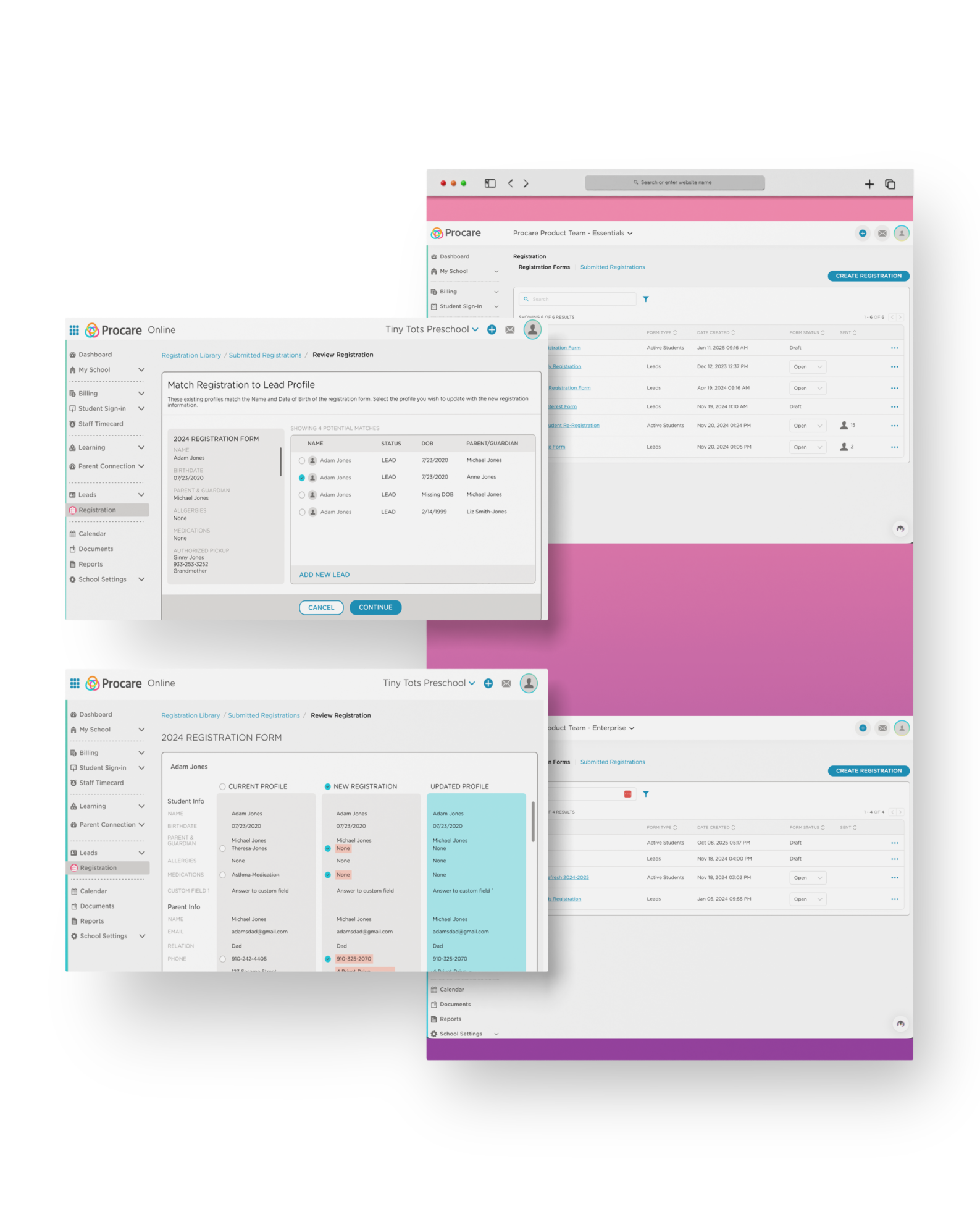
We designed a holistic registration experience grounded in a deep understanding of customer workflows and mental models, while intentionally delivering it in phased increments that could be executed through short, focused sprints. This approach allowed us to honor long-standing customer requests without being blocked by legacy constraints, and to move the system toward a more scalable future state.
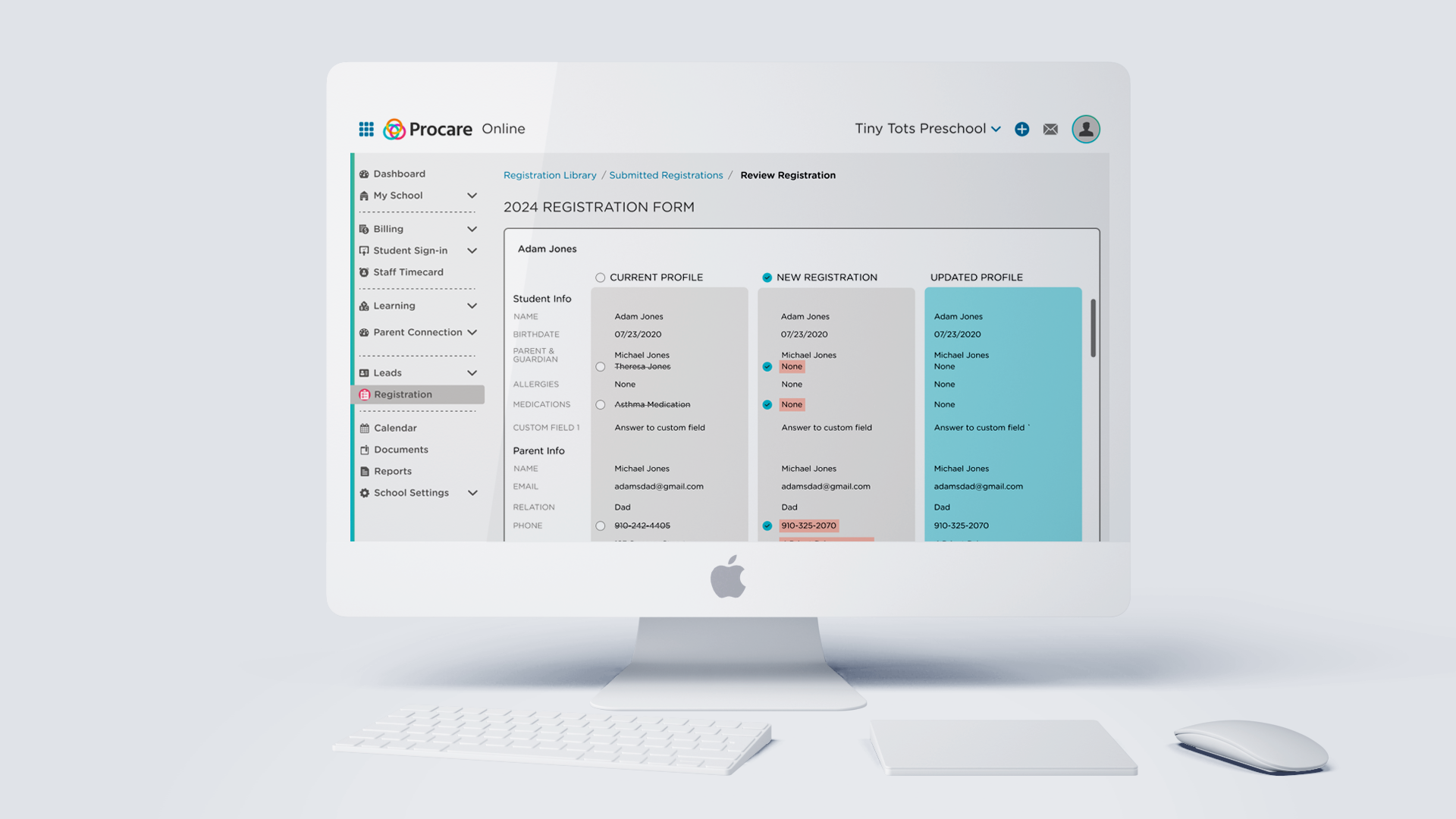
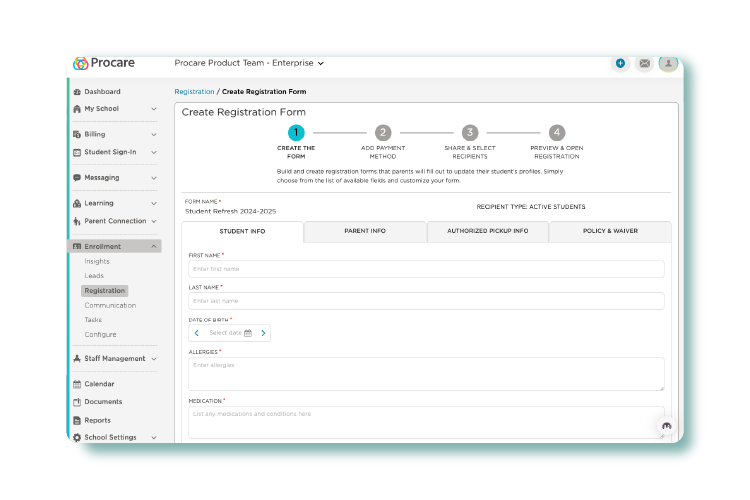
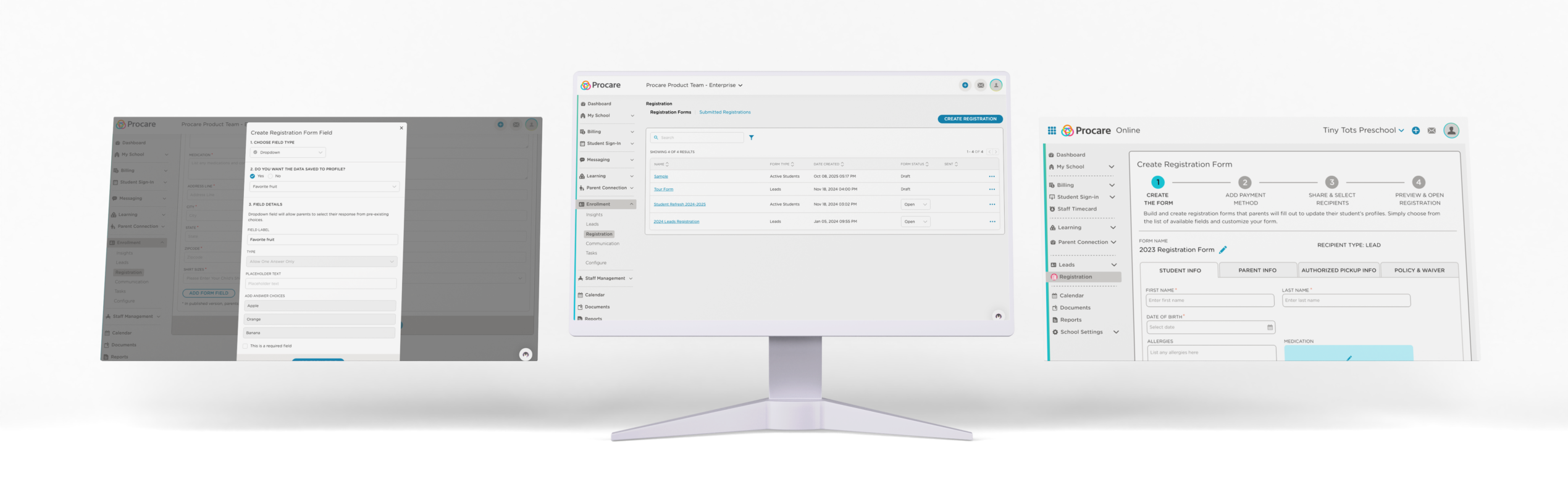
The solution introduced configurable, multi-step registration forms that supported both initial registration and annual re-registration—reflecting how centers actually operate year over year. We also designed an information merge experience that automated the majority of data reconciliation while preserving director control, enabling them to maintain accurate, clean student profiles without sacrificing efficiency. Together, these features reduced manual effort, respected existing operational practices, and laid the groundwork for a more extensible registration system.
UX Process
Don’t bite off more than you can chew
I applied learnings from previous projects to approach this work with intentional scope discipline. While the gap between user needs and the existing system was significant, I resisted the urge to solve everything at once. Instead, I focused on identifying the highest-leverage problems and structuring the work into clearly defined phases that could be delivered, validated, and iterated on over time, which is easier said than done. Once there’s a vision for the feature, it’s sometimes hard to take that esoteric vision and reverse-engineer it into something that can be executed in smaller chunks.
This approach allowed the team to make meaningful progress despite the size of the undertaking. By sequencing foundational improvements before more complex enhancements, we were able to ship value early, reduce risk, and adapt as we learned—turning a large, ambiguous problem into a series of manageable, forward-moving steps.
UX Process
Understanding the system before solving the problem
One of the key learnings from this work was the importance of deeply understanding existing functionality and its underlying pain points before committing to solutions. Early in the project, I focused on addressing the problems outlined in the initial briefing and product kickoff. While those problems were valid, time constraints limited deeper validation, and it became clear that there were smaller, more foundational issues embedded in the system that needed to be addressed first.
As we dug into the workflows and constraints, it surfaced that these underlying issues were amplifying the larger, more visible problems we had been asked to solve. Without first stabilizing the fundamentals, any solution layered on top would have only made a bigger mess. This reinforced a critical principle for me: meaningful, scalable solutions only emerge once you fully understand how a system works today. Deep system understanding isn’t a nice-to-have—it’s a prerequisite for solving the right problems in the right order.
Final Takeaways
Building systems and skills
This project was a turning point in how I approach complex, systems-heavy work. The scale of the problem—spanning legacy constraints, deep workflow gaps, and competing priorities—forced me to level up in how I scoped, sequenced, and delivered design. It required balancing ambition with restraint, vision with feasibility, and speed with durability.
More than any single outcome, this work sharpened my ability to navigate ambiguity, identify foundational problems, and move large initiatives forward through incremental progress. It’s where I truly “cut my teeth” as a senior designer—learning how to make hard tradeoffs, partner deeply with engineering and product, and design solutions that hold up over time.
More Projects